
Articles on methodology
Everyone can swipe. Almost no one can type
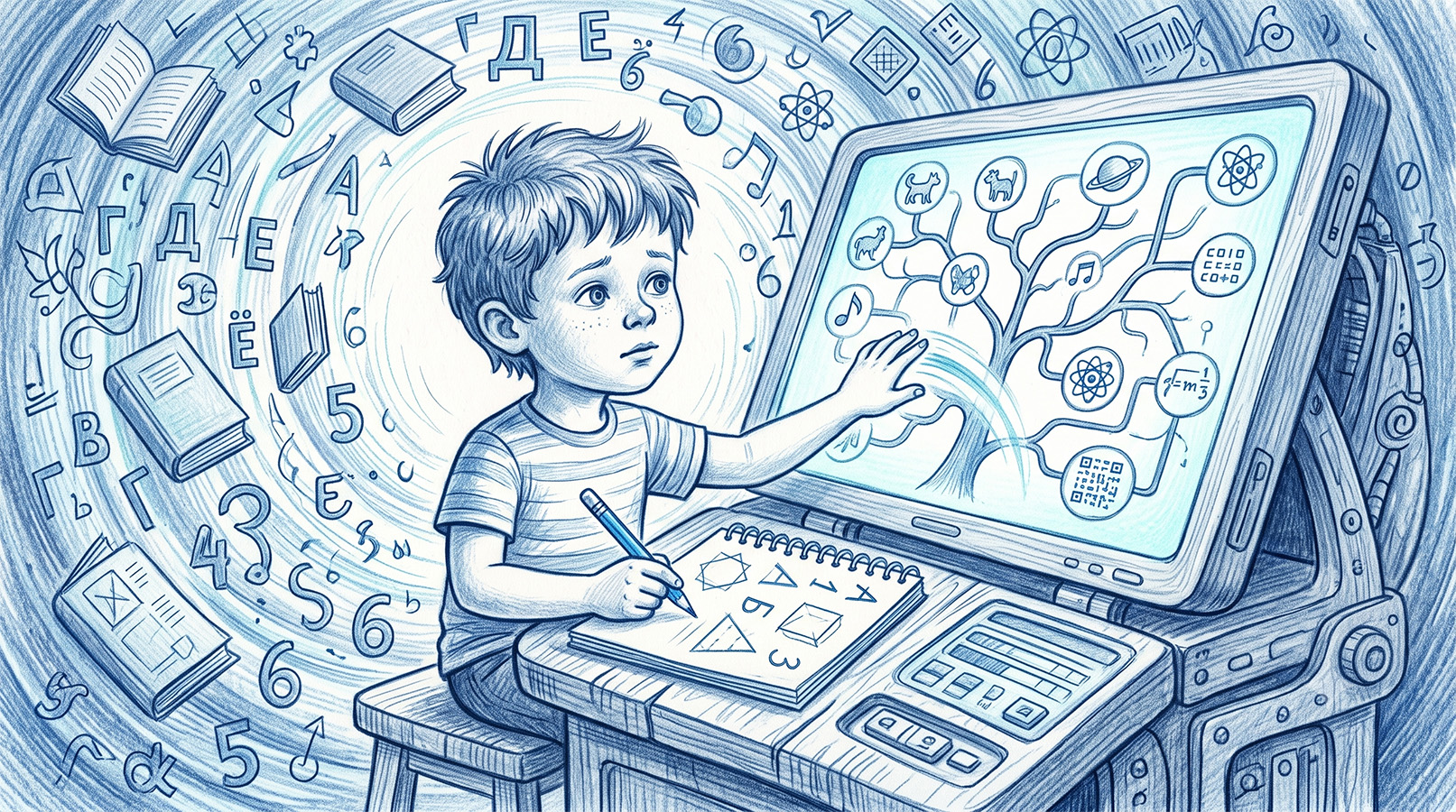
A touchscreen is direct manipulation; a mouse is not. Why fine motor skill at five predicts school attainment, and why schools sit between the two.
A five-year-old finds the video they want in seconds, then arrives in Year One unable to land the cursor on a button. There is no contradiction here. A touchscreen is direct manipulation: the finger touches exactly what the eye is looking at. A mouse works differently. The hand travels horizontally across a desk, the cursor travels vertically up a screen, and between them sits a transformation that has to be learned. A keyboard adds another layer — the link between a letter on the screen and a place under a finger you cannot see. Fluency in the first says nothing about the second. The “digital native” was taken apart in the late 2000s: there were no data behind the idea, and international comparisons of computer and information literacy show the same thing year after year — the proportion of pupils who can confidently do anything beyond a browser and a messaging app is small everywhere.
This is not only a matter of convenience. Fine motor skill on entry to school predicts attainment in mathematics and reading about as well as the ability to sustain attention — a stable finding across large samples. The reason is not mysterious: a precise movement demands the same planning, control and holding of a goal that a school task does. Motor experience changes the cortex itself: in string players, the representation of the left hand’s fingers is markedly enlarged. Research on handwriting — Karin James with pre-schoolers, Audrey van der Meer in Trondheim — shows that writing by hand recruits more of the brain than typing the same letter. This is often read as a verdict against the keyboard. It is better read as a scale. The hand with a pencil is richer than the keyboard; the keyboard is richer than the swipe. The swipe is the poorest movement of the three: one finger, one plane, no resistance from the material.
School has ended up in between. Typing was once a subject of its own; now it is assumed the skill will simply appear. It does not — what appears is an adult who types with two fingers. Examinations, meanwhile, are moving onto computers, and a written paper starts to measure typing speed instead of knowledge of the subject. At home, some children have nothing but a parent’s phone: if school does not teach the mouse and the keyboard, nothing will. And almost nobody has moved across wholesale — the computer room sits apart, two hours a week, so the skill is never folded into ordinary work and never reaches automaticity. The equipment is there, the expectations are there, the teaching is not.
The conclusion is neither to confiscate the tablet nor to postpone the computer until secondary school. The computer is a five-year-old’s reality, and the question has long since stopped being whether to allow it. We go on writing by hand and we go on typing: these are different skills for different tasks, and neither cancels the other. The line runs elsewhere. Swiping is a way of consuming. The mouse and the keyboard are a way of making. The hand should be trained on them as early and as systematically as it is trained on a pencil — in short sessions, with the correct movement shown, repeated to automaticity, at five and six, while movement still forms easily.