
Tips for parents
Ban it or negotiate
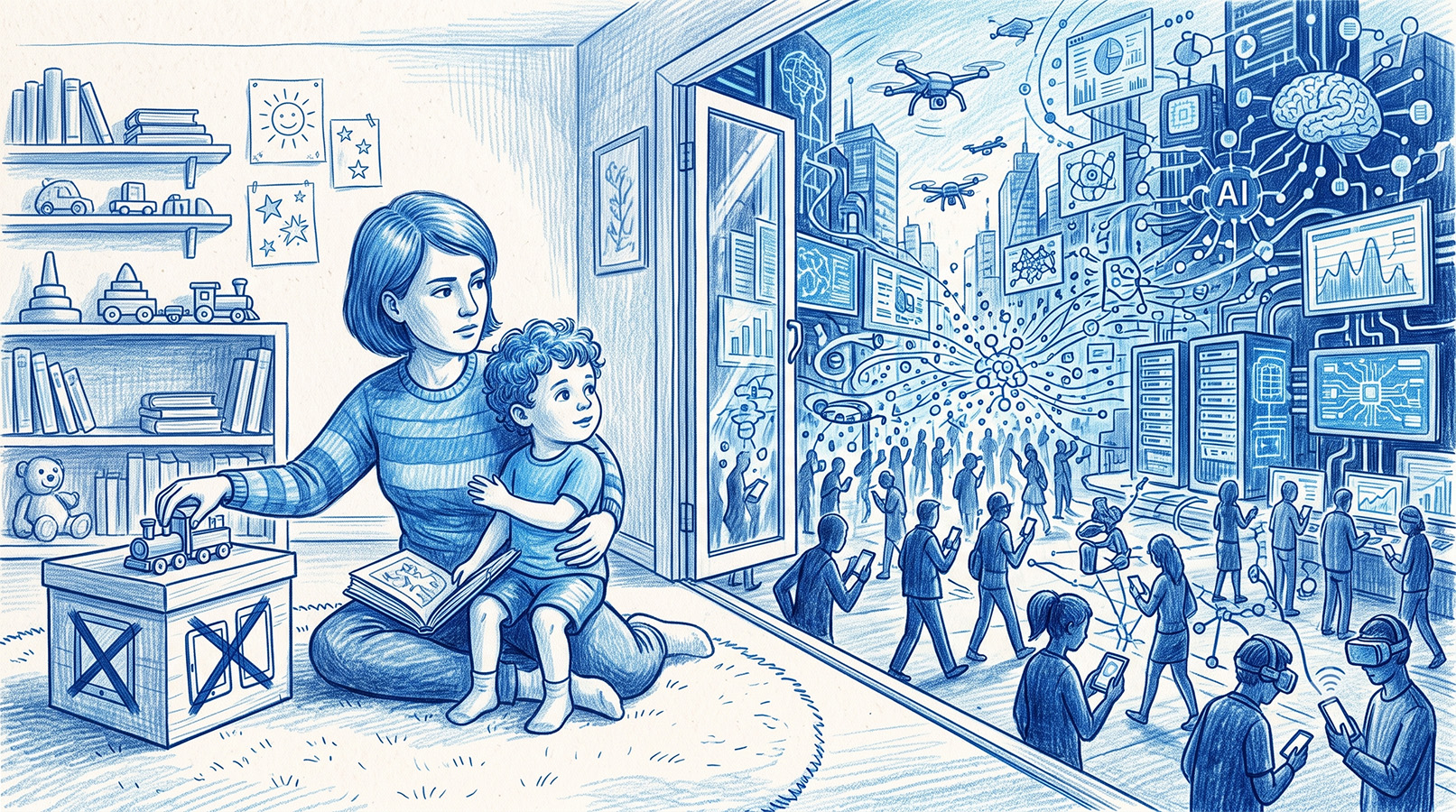
Both sides of the screen-time argument, and the compromise we think workable: not half an hour a day, but a distinction — is the child consuming or making?
Since the Stone Age, human beings have put outside themselves whatever they lack against their neighbours on the planet. A knife instead of claws, a hide instead of fur, fire instead of warm blood, a wheel instead of stamina. Writing was the same move applied to memory, and it produced the first recorded panic. In Plato’s Phaedrus, King Thamus answers the inventor of writing: people will stop exercising memory, and will seem to know without knowing. The objection is not stupid, and it is partly right — we do hold less by heart. But the gain turned out to be incommensurate with the loss. Everything since has gone round the same circle: novels corrupted the young, the telephone destroyed conversation, television destroyed imagination, video games destroyed all of it at once. Amy Orben has described this as a recurring cycle: alarm, a wave of research, a fading, a new technology, a new alarm.
It does not follow that there is nothing to worry about. Today’s argument is a serious one, and a parent is better off knowing both sides. Jonathan Haidt, in The Anxious Generation, argues that childhood has been rebuilt around the smartphone, that anxiety and depression among adolescents rose sharply from the early 2010s, and that no single family can handle this without external limits. His critics — Candice Odgers, Andrew Przybylski, Orben herself — do not dispute that adolescents are worse off. They dispute the explanation: across large samples the association between screen time and wellbeing turns out to be very weak, a fraction of a per cent of the variation, and the direction of cause is not established — it may be that adolescents having a harder time use their phones more, rather than the reverse. The argument is not settled. Which means both extremes — ban it until sixteen, and relax, it’s fine — currently rest on conviction rather than evidence.
Some things are known more firmly. First, what matters is less how much than instead of what: where harm shows up most clearly, it runs through displaced sleep, and an hour before bed costs far more than an hour after school. Second, prohibition as a method has a short shelf life. Sonia Livingstone, who has studied digital parenting for years, distinguishes restriction from engagement: with young children restriction works, with a teenager it fails — and what remains is a child who has learned to hide a screen rather than to choose. Research on motivation says the same from the other side: support for autonomy produces durable behaviour, control produces behaviour in front of witnesses. Hence the compromise we think workable. Rules are needed, but explained and set together. Not “half an hour a day” but a distinction: is the child consuming, or making? A five-year-old sees a computer regardless; the question stopped being whether to allow it and became what they do there and whether they know why. A computer at which something is made stops being a magical toy and becomes a tool — and nobody has to be dragged away from a tool. In our own lessons for five-year-olds, about eight minutes a week go to a screen and everything else is done on paper; the screen is used exactly where paper does not work.
All of this holds for artificial intelligence, with one qualification. What we put outside ourselves before was memory, arithmetic, a sense of direction — important things, but auxiliary. What is being put outside now is reasoning itself, and that is a wager of a different kind: Thamus’s objection, wrong about writing, here at least deserves a hearing. So the conversation with a child should be about what this thing can and cannot do, not about minutes. It is endlessly patient, it will explain a tenth time without sighing — that is its strength, and it would be a mistake not to use it. It will also hand over an answer where a child would be better off struggling, and it states falsehoods with confidence — those are its weaknesses, and recognising them will have to be learned, as people once learned not to believe everything in print. A ban will not help here: AI is not going away, and a child who has been forbidden simply learns to use it in secret and badly. Understanding — where it helps, where it hinders, where it lies — lasts longer, and holds when you are not in the room.