
Teaching materials
The teacher's kit: what has changed
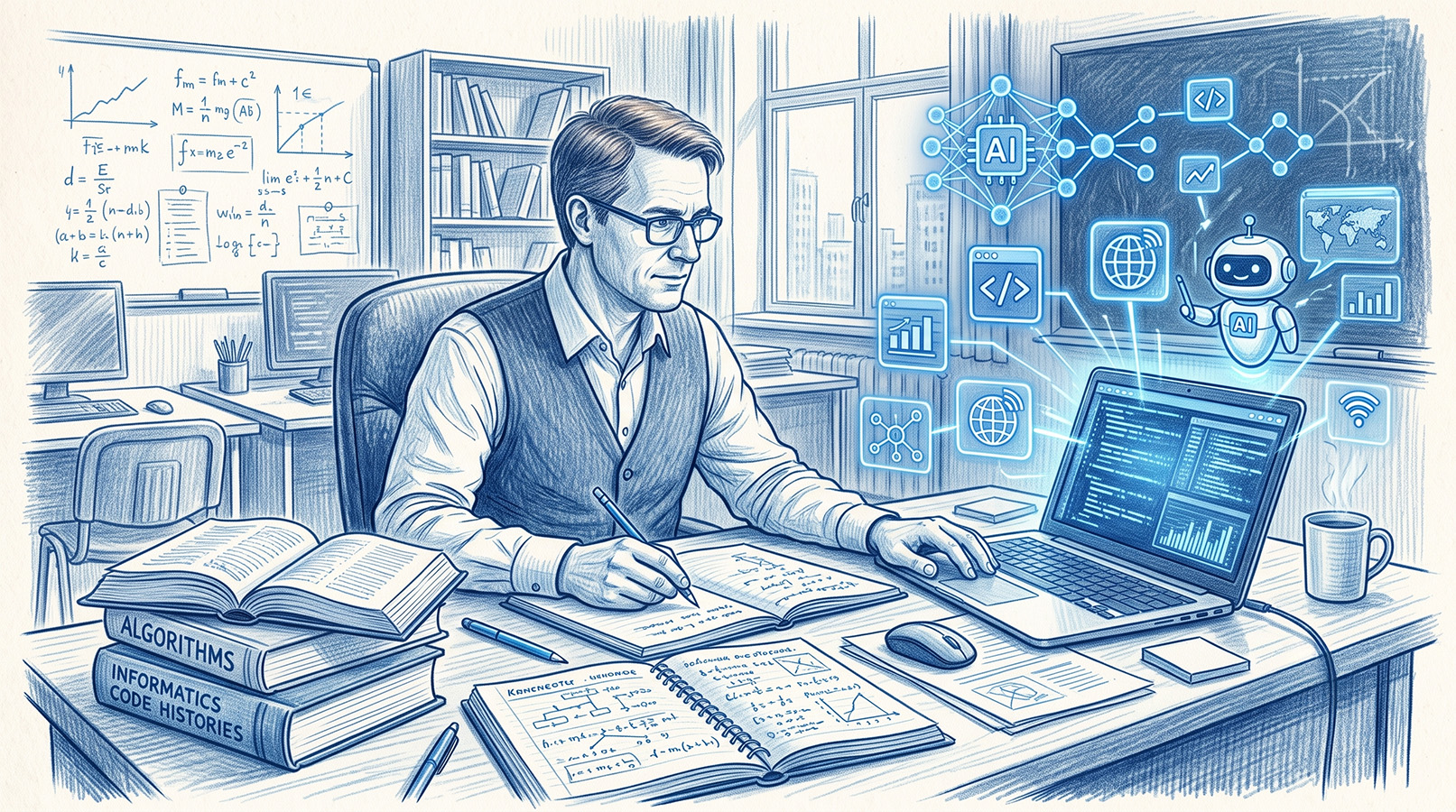
A modern kit is measured not by how much material it holds but by how much preparation it removes — and why teacher and pupil are becoming a triad.
A classic kit was three things: a textbook, a workbook, a teacher’s book. And the teacher’s book was usually a book of recommendations — broad aims, a rough allocation of hours, an instruction to consolidate the material. The lesson itself the teacher wrote. Today that is the most expensive part of the job: not explaining the topic but assembling the lesson. A modern kit is therefore measured not by how much material it contains but by how much preparation it removes. A useful teacher’s book is a lesson ready to teach: the aim, the sequence, what to say, where a child will stumble, what to give the ones who finish early. Barak Rosenshine once reduced working practice to about ten principles — a short review at the start, small steps, guided practice, constant checking for understanding, scaffolds that are later withdrawn. A kit either helps a teacher do this or leaves them alone with it.
The computer is not an alternative to the book here, nor a pleasant extra. The division is fairly simple: paper explains, the screen drills. A still page a child studies at their own pace explains better than an animation; practice to automaticity, by contrast, needs repetition, an immediate response to error, and a patience paper does not have. Hence a practical requirement: the digital part belongs inside the textbook, not somewhere for the teacher to go and find. An app downloaded on its own, unconnected to the programme, is entertainment at the end of term, not teaching. And a machine per child is not needed: four or five computers for a group of twenty are enough if the lesson is planned around a queue rather than a simultaneous start.
The digital part gives what paper never can: it sees what exactly went wrong. Not “the topic is 70 per cent secure” but which action a child gets stuck on, and how many times in a row. Dylan Wiliam spent years arguing that assessment is useful precisely to the degree that it changes the next step in teaching rather than filling in a report. There is a trap here, and it is better said plainly: data nobody intends to read adds work and returns nothing. The right question to ask of any kit is not whether it gathers statistics but what the teacher is supposed to do tomorrow, having seen them. If there is no answer, the statistics are surplus.
And here is what all of this has been leading to. A teacher with thirty children — and in a learning centre it can be a hundred — physically cannot run thirty routes. They run one, the average one, and lose both the children for whom it is too fast and those for whom it is too slow. That is a limit of a human being, not of a qualification. An individual pace for each child is exactly what a neural network can already manage: explain it a third time to one, hand a harder problem to another, without tiring and without showing irritation. Comparisons between tutoring systems and human tutors — Kurt VanLehn’s work is central here — found the gap far smaller than is usually assumed. But this does not make it a replacement for the teacher. Noticing that a child is stuck on something other than the material is beyond a machine. So is holding the effort in place: Robert Bjork called useful obstacles desirable difficulties, and an answer handed over instantly destroys exactly those. So the pair of teacher and pupil becomes a triad, each with a part: the network holds the pace, the teacher holds the person, the child does the work. How that triad works in our own material is a subject of its own, and we will come back to it.